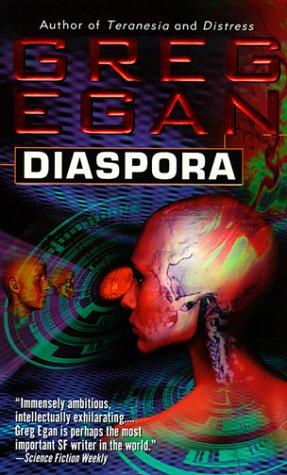
The first section of this book, the digital birth of Yatima inside a polis, watching consciousness get assembled out of decision trees and orphan-raised by a community of minds, is genuinely one of the best pieces of hard sci-fi writing I’ve come across, dense and strange and moving all at once. I told a friend it was mind-blowing before I’d even finished that opening stretch, and I stand by it. Egan is doing something almost nobody else attempts, building an alien psychology from the substrate up rather than just bolting a funny hat onto a human brain.
Then the book keeps going, and the thing that made the opening so good, the willingness to sit inside pure concept without a human anchor, starts working against it. Humanity splits into three branches, digital citizens in their polises, fleshers who stayed embodied, and gleisner robots, and the middle stretch drags you through cosmology and higher-dimensional physics with characters who are barely distinguishable from each other, mostly defined by which faction they belong to rather than who they are. One reader put it as more science than fiction, and that’s fair, there are stretches that read like a very good popular physics essay wearing a plot as a costume.
Where it works, and where it really shines, is the sheer commitment to the premise, running multiple instances of a single “person” and asking what happens when they diverge and have to reintegrate, or refusing to, is a question almost nobody else in the genre takes seriously enough to sit with for three hundred pages. It’s cold, arrogant about its own materialism in a way that put some readers off entirely, and light on anything resembling warmth. Four stars for ambition and for that unforgettable opening, with a real dip through the middle that a more patient reader than me might forgive faster.