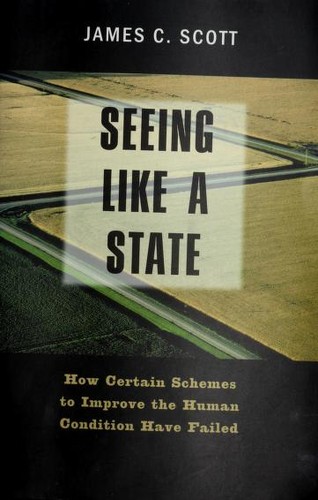
Somebody handed me this years ago describing it as “the forestry book,” which is a terrible pitch and also, weirdly, accurate to how it opens. Scott starts with German scientific forestry in the eighteenth century, where foresters replanted natural woodland as neat single-species rows because rows were easier to count, tax, and harvest, and the forests died a hundred years later because nobody had planned for undergrowth, soil chemistry, or anything a spreadsheet doesn’t track. That’s the whole book in miniature, and once you see the pattern you cannot stop seeing it.
The idea he builds from there, that states need populations and landscapes to be “legible,” simplified into grids and last names and standard units, in order to govern them at all, and that the simplification itself destroys the local, uncodified knowledge that made the original system resilient, is one of those arguments that rearranges how you read the news. I found myself thinking about it reading about a city rezoning plan a few weeks after finishing this. The chapter on Brasilia in particular, a capital city designed from scratch to be perfectly rational and legible from above, and famously alienating and unlivable at street level, is the kind of case study that sticks.
It’s dense, academic in register, and Scott occasionally repeats himself getting a point across that landed three chapters earlier. I skimmed a stretch in the middle the way one reader online admitted to doing, hopping the case studies rather than every page of connective tissue, and didn’t feel like I’d missed the argument. Worth every one of its four stars for anyone who’s ever sat through a project that failed for reasons nobody wrote down in the plan.