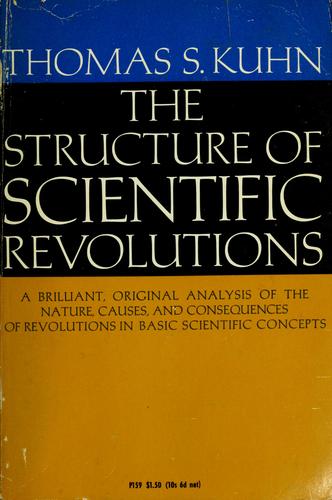
Everyone already knows the word “paradigm shift” whether or not they know where it came from, which is its own strange tribute, a phrase escaping its book so completely that most people using it have never touched the source. I finally sat down with the source. Kuhn’s basic move is to argue that science doesn’t creep forward one careful fact at a time, it lurches, long stretches of “normal science” mopping up problems inside an accepted framework, punctuated by crises where the framework itself gets thrown out and replaced by something the old guard often can’t even fully evaluate on its own terms.
What actually humbled me reading it is how much this applies outside science, to any field with an established orthodoxy. Kuhn is careful and a little dry about it, this isn’t a book that reaches for drama, but the core claim, that practitioners inside a paradigm are often structurally unable to see the anomalies that will eventually topple it, unsettled me in a way a flashier book wouldn’t have. It gives real intellectual cover to disruptive thinking, and just as much cover to crankery, which is a tension the book itself gestures at without fully resolving.
I’ll admit the language gets terse in stretches, dense academic prose from 1962 that assumes a reader already fluent in philosophy of science, and I had to reread a few paragraphs to be sure I had the argument right rather than a simplified version of it I’d absorbed secondhand from a decade of other people quoting Kuhn at me. Worth the effort. Four stars for a book that’s more foundational than most people who use its vocabulary daily have actually read.